
Seizing the Opportunity: How the Energy Performance Directive Hopefully will Spark a Renovation Boom

I was recently at an AEC Hackathon in Munich discussing with a product leader of a global 3D scanner company, and he mentioned how he foresees a strong refurbishment push. Especially with the recent release of the EU directive for the 'Energy Performance of Buildings' (EPBD).
The substance of the EPBD is far beyond the scope of this post, but in essence it aims to significantly enhance the energy efficiency of buildings across the European Union. It sets minimum energy performance standards for both new and existing buildings. This encourages renovations that improve energy efficiency and the use of renewable energy sources. The directive also emphasizes the goal of achieving a zero-emission building stock by 2050, whilst promoting the reduction of greenhouse gas emissions throughout the entire lifecycle of buildings. Furthermore, it calls for the implementation of renovation passports, energy performance certificates, and the integration of smart technologies to foster a more energy-efficient and sustainable built environment.
At the time I hadn't heard of this directive, so I noted down, realising I should look into it after a good weekend of hacking. That conversation had one clear conclusion , which for anyone who may have gone through the process of recently trying to buy a house may be quite obvious: the need for renovating the housing stock in Europe is an extremely pressing challenge.
Here's a rough estimate of the scale of this market:
As per the data which is publicly available via the EU Building Stock Observatory, across the EU27 there's a total of 125million buildings, with the following age distribution.
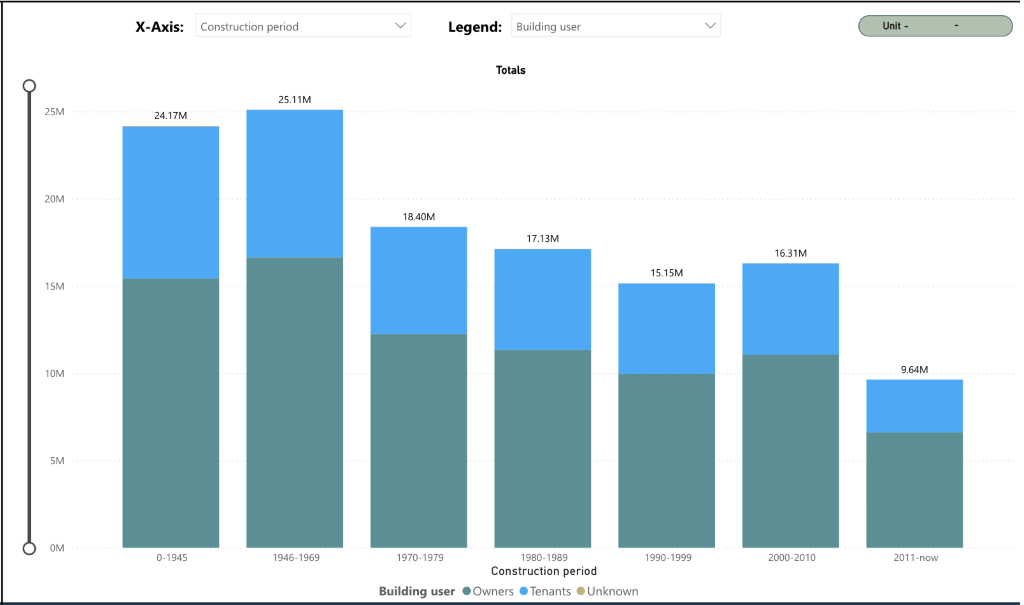
In summary over 53% of building were built before the 1980 and 79% before the 1999s, 67.7 and 99.9million buildings respectively. The European Building Stock Observatory has another interesting dataset, which is the rate of total innovation, split by country. For the sake of simplicity if we take average rate from the EU27, 5.8% have been renovated.
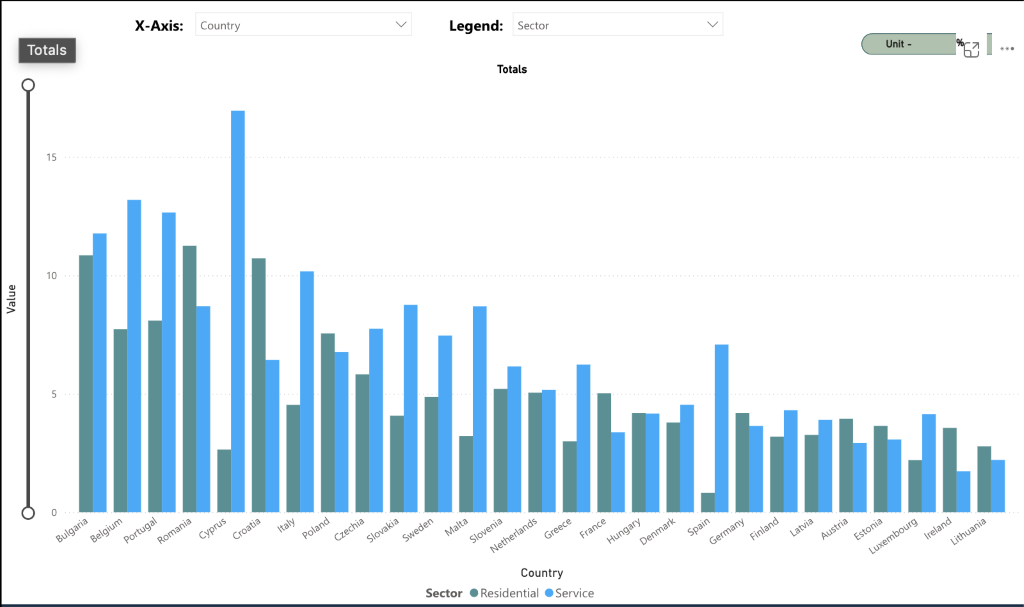
Let's say a building will need to be renovated at least every 25-30 years, we can be conservative and assume that all the building stock from the 2000 onwards is still not refurbishment worthy and hence should be excluded from the market sizing. With a total 99.9million buildings (pre 1999s) which are of refurbishment age, of which 5.8% have already been refurbished, leaving the continent with 94.1million buildings that still need to be refurbished.
Now calculating the average value of renovating a building is very complicated as its size, age, objective and purchasing power dependent. However if we assign even an extremely conservative value of 50kEur per building the total renovation market is a 4.7 trillion euro market across the EU27. Not only is this an unprecedented opportunity to improve the quality of life of citizens of the European continent, the opportunity to innovate and build large successful business is also extraordinary.
A Space for European Startups to Shine:
The final thesis I want to bring forward in this post is that I see this an area where European startups absolutely have a right to win. I recently moved back to Europe from the United States, and due to building codes but also cultural dynamics the vast majority of buildings in North America are wood framed single family homes. The approach in most cases is to rebuild rather than carry out extensive renovations, and also because of the framing and extensive use of drywall partitions, the kind of materials and techniques are different to Europe.
Hence, I believe the innovation in terms of software, hardware and services which come out of North America will be ill placed in the European market. Rather this is where home grown startups should be motivated and well positioned to tackle this immense forthcoming opportunity.
One such startups that caught my attention recently was German startup Enter. We haven't had any contact with anyone from Enter (although if anyone from Enter is open to it, we're happy to highlight their impressive business 😉 ), yet their traction provides insight into the potential of this domain.
Enter’s Unique Approach
- Digital Survey: Homeowners answer just 8-9 questions.
- AI Analysis: Enter’s system processes these answers into 250 data points.
- Accurate Assessment: This method achieves 90% accuracy in identifying energy-saving potential.
- On-Site Verification: Energy consultants visit to verify and gather more data.
- Digital Twin: Homeowners receive a virtual replica of their building.
This process provides a clear roadmap for improving energy efficiency, all starting from a simple questionnaire. Furthermore Enter goes beyond energy assessments:
- Handles subsidy applications for renovations
- Offers financing options
- Facilitates contractor bidding process
- This comprehensive approach makes energy-efficient upgrades more accessible and affordable for homeowners.
They've been rewarded by their vision so far, as they've managed to raise 19.4mEur in a Series A round led by Target Global. Also in the round were VC firms Coatue, Foundamental, A/O Proptech and Partech, all important investors in the construction domain.
I'm sure Enter is just one of the many startups we'll see emerging in the exciting renovation space in the near future. What's your take on the EU directive for the 'Energy Performance of Buildings', and the renovation space more broadly?
Cheers,
Site Steer team
If you work in construction, climate tech and would like to reach out to us to share about some interesting project, innovation or startup please reach out to at sitesteer.ai@gmail.com!